- Materials
Choose the Material.
Plan Around Its Behavior.
Part of Dawnmill’s Integrated Precision Machining Capabilities.
Material choice changes cutting strategy, part support, burr control, stability, finishing and inspection. Dawnmill reviews those effects against the finished requirement.
- Aluminum
- Stainless Steel
- Copper & Brass
- Kovar & Plastics
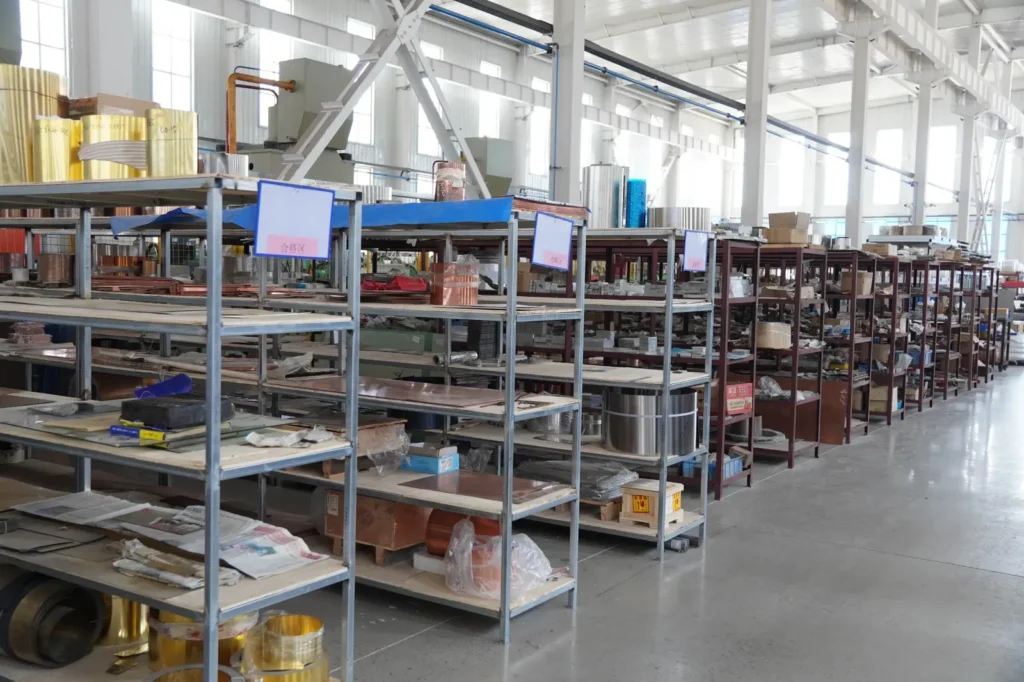
Dawnmill material storage · real factory environment
- Material range
Common Materials.
Application-Specific Choices.
Final material selection remains a customer engineering decision; Dawnmill contributes practical manufacturing feedback.
Aluminum Alloys
- 6061
- 6063
- 7075
Stainless Steel
- 304
- 316
- Other specified stainless grades
Copper & Special Alloys
- OFHC copper and brass
- Kovar
- Specified special alloys
Engineering Plastics
- PEEK and POM
- PTFE
- Nylon
- Technical specifications & process limits
Define the Range.
Then Commit.
The range below shows what matters for this topic. The applicable process, limits and verification method are confirmed against the actual drawing, material and final condition.
Project-specific values confirmed before production.
Metals Aluminum 6061 / 6063 / 7075, stainless 304 / 316, OFHC copper, brass and Kovar. | Plastics PEEK, POM, PTFE and Nylon reviewed against stability, burr control and functional requirements. |
Traceability Material certificates and lot/part identification are available when specified for the project. | Substitution No material substitution is assumed; alternatives are discussed and require customer approval. |
- Material review
Start with the Grade.
Finish with the Function.
We confirm the specified grade and review the material characteristics that materially affect manufacturing.
DFM REVIEW
Tooling & Cutting Strategy
- Select practical tools, parameters and operation order for the material behavior.
- Consider thin walls, flexible features, stock condition and dimensional movement.
PROCESS CONTROL
Burr, Heat & Handling
- Plan edge quality, thermal effects and surface protection where they matter.
- Adapt workholding, tooling, sequence and secondary processes.
INSPECTION & RECORDS
Material Confirmation
- Work from the specified grade and agreed supply condition.
- Provide material certificates when included in the project requirement.
PROCESS LOGIC
Confirm the Grade. Build the Right Route.
Material information enters the project before tooling, finishing and inspection decisions are finalized.
01
Confirm Specification
02
Plan Manufacturing
03
Control the Part
04
Protect & Document
- Material confidence
Know the Material.
Control the Requirement.
Traceability and inspection needs are aligned with the project rather than assumed from a generic checklist.
REPRESENTATIVE ENGINEERING SCENARIO
Mixed-material component family
Illustrative review scenario—not a published customer case. Customer parts and records remain confidential.
Challenge
Aluminum, copper and engineering-plastic parts share interfaces but behave differently during machining and finishing.
Process Strategy
Adjust tooling, support, material-removal sequence and surface planning for each released material.
Inspection
Keep material identity and the agreed certificate scope connected to each part number.
Result
Target: a controlled materials for precision manufacturing route that meets the released drawing and agreed final-condition checks.
CAPABILITY EVIDENCE
Experience across common aluminum, stainless, copper, Kovar and engineering plastics
Material certificates available by agreement
Manufacturing route reviewed by grade and finished condition
- Related Capabilities
Continue Without
Returning to the Menu.
CNC Machining
See how geometry and material behavior shape the machining route.
Finishing & Secondary Processes
Connect the base material to its final surface condition.
Engineering & Quality
Define certificates, inspection and traceability around the project.
- Questions before the RFQ
Clear the
Important Doubts.
Four topic-specific answers keep the next step practical and direct.
Can Dawnmill suggest an alternative material?
We can explain manufacturing implications and discuss options, but any substitution requires customer engineering review and approval.
Are material certificates available?
Yes, when the required certificate type and traceability scope are identified during quotation.
How is Materials for Precision Manufacturing feasibility confirmed?
We review the actual drawing, overall size, feature access, material, tolerances, finish and inspection method, then confirm the applicable route and limits.
Can this process be connected with other Dawnmill capabilities?
Yes. CNC, EDM, stamping, secondary work, finishing and inspection can be coordinated when the finished component requires a multi-process route.
Demanding Material?
Send the drawing and material specification. We’ll review the manufacturing considerations that affect the part.
Factory, equipment and inspection photos show real Dawnmill facilities. AI-generated visuals are used only for confidential component and application concepts tied to Dawnmill’s served industries and available manufacturing processes; they are not customer parts, factory evidence or test records.