- Finishing & secondary processes
Finish the Part.
Keep the Route Connected.
Part of Dawnmill’s Integrated Precision Machining Capabilities.
Dawnmill coordinates surface preparation, finishing and secondary operations around the dimensions, interfaces and delivered condition defined for the component.
- Mechanical Finishing
- Electroplating
- Anodizing
- Coating
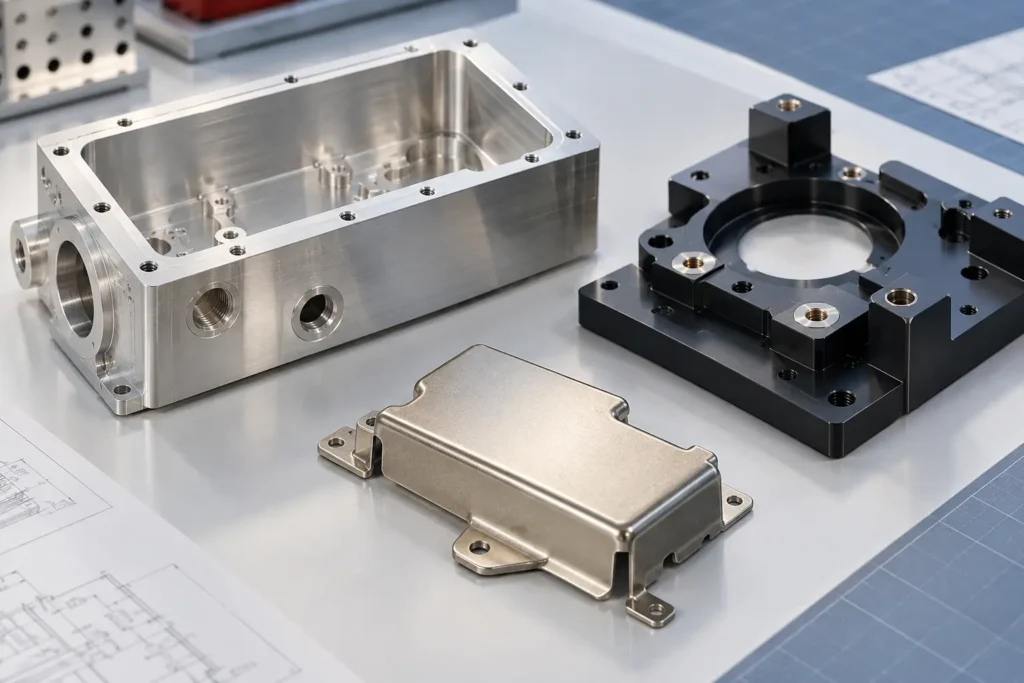
AI concept · commercial RF, semiconductor-equipment and stamped-electronics components · deburring and coordinated finishing context
- Process range
Different Treatments.
One Finished Requirement.
Process ownership is kept simple for the customer even when the route combines Dawnmill operations and qualified finishing support.
Mechanical Preparation
- Deburring
- Mechanical finishing
- Edge and surface preparation
Electroplating
- Gold, silver or nickel requirements
- Selective or localized areas
- Combined in-house and qualified process support
Conversion & Coating
- Anodizing
- Spray coating
- E-coating
Secondary Completion
- Laser marking
- Assembly and integration
- Final cleaning and packaging
- Technical specifications & process limits
Define the Range.
Then Commit.
The range below shows what matters for this topic. The applicable process, limits and verification method are confirmed against the actual drawing, material and final condition.
Project-specific values confirmed before production.
Process scope Deburring, mechanical finishing, anodizing, electroplating, selective plating, coating, marking and assembly support. | Ownership Deburring and mechanical secondary work are controlled in-house; some finishing is in-house and some uses qualified partners. |
Review inputs Base material, final finish, color/specification, masking, protected interfaces and appearance criteria. | Dimensional effect Coating or plating thickness, edge break and handling are considered against the final drawing requirement. |
- Finishing review
Plan for the Finish
Before Cutting Metal.
We review the final condition while machining allowances, masking, handling and inspection remain practical to control.
DFM REVIEW
Pre-Finish Dimensions
- Consider how the specified treatment relates to fits, threads and critical surfaces.
- Identify surfaces that must remain untreated or receive a different condition.
PROCESS CONTROL
Surface Preparation
- Define deburring, mechanical finish and cleaning requirements before treatment.
- Complete deburring, mechanical finishing, cleaning and masking preparation.
INSPECTION & RECORDS
Critical Features
- Confirm agreed dimensions and functional interfaces in the delivered condition.
- Review selective areas and visible treatment coverage against the requirement.
PROCESS LOGIC
Prepare. Protect. Finish. Verify.
One responsible route keeps the component requirement connected across internal and qualified external operations.
01
Confirm the Requirement
02
Prepare the Component
03
Apply the Finish
04
Verify & Release
- Delivered condition
Check the Part
After the Finish.
The final component—not the intermediate operation—is the point of release.
REPRESENTATIVE ENGINEERING SCENARIO
Aluminum housing with selective protection
Illustrative review scenario—not a published customer case. Customer parts and records remain confidential.
Challenge
Anodized surfaces and protected electrical or sealing interfaces must coexist on one component.
Process Strategy
Define masking and pre-finish allowance before critical dimensions are completed, then coordinate the approved finishing route.
Inspection
Review the final condition, protected areas and agreed dimensional or visual requirements.
Result
Target: a controlled finishing & secondary processes route that meets the released drawing and agreed final-condition checks.
CAPABILITY EVIDENCE
In-house deburring and mechanical finishing
Electroplating is partly in-house and partly coordinated
Anodizing, spraying and e-coating may use qualified regional partners
- Related Capabilities
Continue Without
Returning to the Menu.
CNC Machining
Plan the machined condition around the final surface requirement.
Metal Stamping & Sheet Metal
Connect stamped geometry, edge preparation and the specified finish.
Engineering & Quality
Define critical features and records before the route begins.
- Questions before the RFQ
Clear the
Important Doubts.
Four topic-specific answers keep the next step practical and direct.
Are all finishes completed inside Dawnmill?
No. Some secondary operations and part of electroplating are in-house; anodizing, spraying, e-coating and selected finishes may be coordinated with qualified regional partners.
Should finishing requirements be supplied before quotation?
Yes. Specification, color, thickness, masking, appearance and protected functional areas can materially change the route and price.
How is Finishing & Secondary Processes feasibility confirmed?
We review the actual drawing, overall size, feature access, material, tolerances, finish and inspection method, then confirm the applicable route and limits.
Can this process be connected with other Dawnmill capabilities?
Yes. CNC, EDM, stamping, secondary work, finishing and inspection can be coordinated when the finished component requires a multi-process route.
Delivered Finished?
Share the drawing and surface requirement. We’ll review the complete route from preparation to final verification.
Factory, equipment and inspection photos show real Dawnmill facilities. AI-generated visuals are used only for confidential component and application concepts tied to Dawnmill’s served industries and available manufacturing processes; they are not customer parts, factory evidence or test records.